
What Are Tube Bundles? Types, Materials, & Applications
Published: June 9, 2026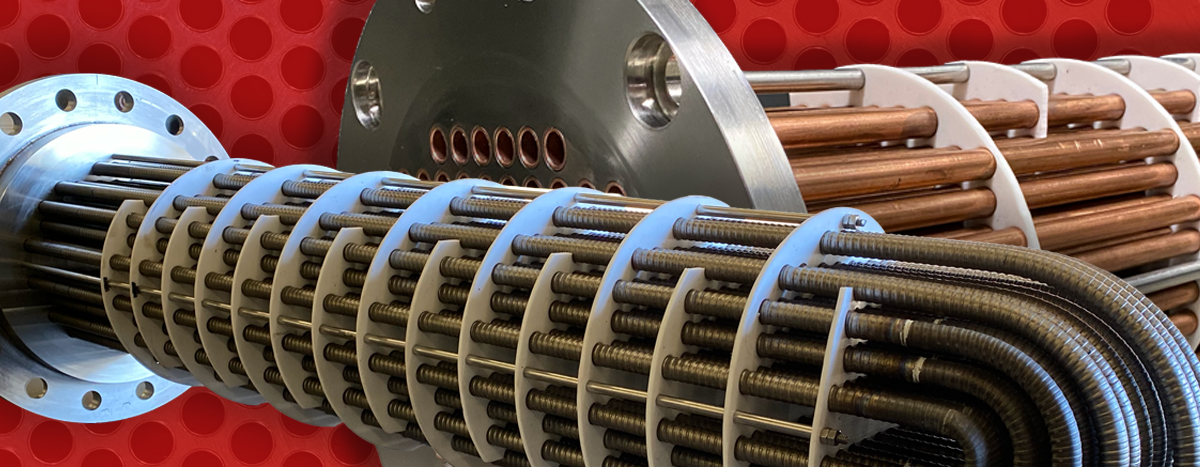 Tube bundles are critical components found in countless industrial and commercial water heating applications. They are deceptively simple assemblies but perform the critical task of creating a barrier between a heat source and domestic water. This allows for safe and efficient heat transfer in a wide range of industries. In this post, we’ll look closer at tube bundles, how they work, where they are used, and …
What Exactly is a Tube Bundle?
A tube bundle consists of a series of tubes that are mechanically expanded into a tube sheet. The result is a high-pressure barrier that allows heat to transfer from the steam within the tubes to the water outside without touching. They come in different configurations, with the U-tube design being the most popular over the last century. Straight tube configurations are available as well. These bundles are typically found in specialty applications such as chemical processing. Straight tubes are usually custom fabricated to the specific needs of the use and environment.
Element Sheath Material
The element sheath material will dramatically affect a tube bundle’s performance, lifespan and cost. Let’s look at a few of the options:
Copper – ideal for standard applications that operate below 150 PSI and temperatures up to 370°. Copper is very reliable and offers excellent thermal conductivity, corrosion-resistance, and is easy on the budget.
Copper – Nickel Alloys – when Nickel is blended with copper, the resulting material is stronger and more durable that copper alone. But there’s a catch: copper-nickel alloys provide slightly lower heat transfer efficiency.
Stainless Steel – this is best for deionized water applications. It provides superior corrosion resistance, is less likely to contaminate the water (which copper can do over time) and provides longer service life in harsh environments.
Titanium – for the most demanding high-temperature applications, titanium is the optimal material. It is by far the most reliable material and will last the longest. While this reduces the need for maintenance, it does come with a higher price tag than the other materials we’ve detailed here.
Single Wall vs Double Wall Tube Bundles
Tube bundles are available in both single and double wall configurations as follows:
Single wall bundles feature a simple design when compared to double wall. Here, the fluid flows through just one layer of tubes. This allows the heat to transfer directly between the fluid inside the tubes and the medium surrounding it, which is usually air or water. Single wall bundles are ideal for standard applications with compatible fluids and stable conditions. They are the more cost-effective option of the two. However, this benefit comes with a trade-off. Unlike double wall bundles, single wall configurations offer less protection against leaks and corrosion.
Double wall bundles use concentric layers of tubes creating a sealed “jacket space” between them. If the inner tube happens to fail, the outer tube acts as a safety net and contains the leak. In addition, double wall tube bundles provide excellent corrosion protection and fluid compatibility. The tradeoff? They come with a higher price tag. Double wall bundles are best suited for systems with high-pressure or toxic fluids. They are also the wiser and safer choice for applications where downtime is costly.
Applications
Tube bundles are found in many diverse applications. In universities and biomedical research facilities, they provide space heating and domestic hot water. They are used in food service and operations for sterilization. Hospitals and surgical centers also rely on tube bundles in autoclaves for sterilization. Additionally, tube bundles can be found in more specialized applications, such as sterilizing waste from international flights at airports.
Serviceability
In a heat exchanger, removable tube bundles have a significant advantage over fixed style units: serviceability. When a tube bundle fails, operators can easily see where it’s leaking and have the bundle replaced. This helps minimize downtime, which is a much-needed benefit across applications. To further minimize downtime, when possible, having spare tube bundles available is a wise choice. Conversely, fixed style configurations or brazed plate exchangers can be more difficult to troubleshoot and repair.
Conclusion
Tube bundles are more than just simple components. They are the heart of heat exchanger systems that allow for reliable and efficient heat transfer for countless uses. Organizations choose tube-bundle based heating solutions since they understand an important fact. When a heat exchanger goes down due to component failure, processes grind to a halt. Tube bundles will provide decades of dependable service, while being easy to maintain and replace. This means operations will stay up and running reliably for long periods of time.
Whether it’s a new installation, or replacement Ace tube bundles provide efficient heat transfer and are available with single or double wall construction. We also offer c complete heat exchanger, our Anchor HX. To find out more about either contact our sales team today to learn more or get a quote.